CoinGoat.com (GOAT)
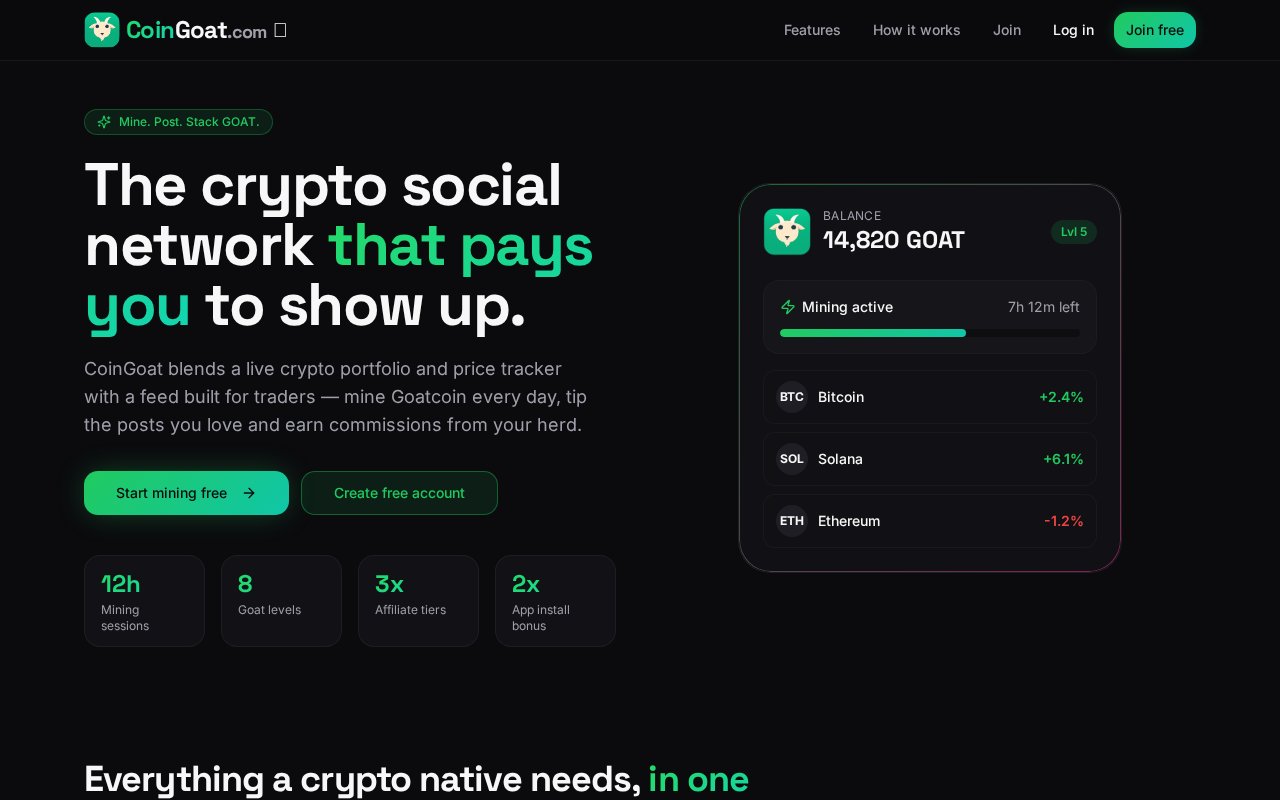
A five-star, ten-out-of-ten portfolio and rank tracker welded to a real social network, with phone-based Goatcoin mining that finally makes a mobile mint feel honest. Goatcoin launches on the Capygram Blockchain in 2027.
The Sniff Test
The words "mine tokens from your phone" have historically been our fastest route to closing a browser tab. That phrase has funded more referral pyramids than it has funded engineering, and our desk has written unkind things about nearly every project that has ever used it. So when CoinGoat.com landed in our review queue with mobile mining printed on the front page, our analysts sharpened their claws and settled in for a short, brutal write-up.
That is not the review we ended up writing. CoinGoat is, first and foremost, a portfolio and rank tracking application that people already use every single day without touching a token at all. The mining layer is bolted onto a product that stands up on its own, and that ordering — utility first, emissions second — is the exact inversion of the failure pattern we normally document.
We spent nine days inside the app. We connected read-only wallet addresses, imported exchange history, followed strangers, argued with them in the comments about whether a 4% weekly drawdown counted as a correction, and watched our own rank on the public leaderboard slide down while better traders climbed over us. At no point did the product feel like a wrapper around a token. It felt like a piece of software that happens to have a token attached.
Our adversarial reviewer — the analyst whose only job is to build the strongest possible case that a project is a scam — came back with a single sentence: "I cannot find the trapdoor." That is how a ten out of ten starts.
Portfolio And Rank Tracking That Actually Works
Portfolio trackers are a crowded, unglamorous category, and most of them fail on the same three things: cost basis, transfers between your own wallets, and anything that is not a plain spot trade. CoinGoat handles all three correctly. Internal transfers are detected and netted rather than being logged as a sale and a purchase, which is the single most common reason competing trackers show a portfolio that never matches reality. Cost basis is configurable, staking rewards are classified separately from capital gains, and LP positions are decomposed into their underlying exposure rather than being reported as an opaque receipt token.
Rank tracking is the feature that turns the tracker into a habit. Every user can opt into a public, verifiable leaderboard scored on risk-adjusted return rather than raw percentage gain, which means a leveraged degenerate who caught one candle does not outrank a disciplined allocator who compounded quietly for a year. Rankings are seasonal, they reset, and past seasons stay on-chain as a permanent record. Nobody gets to delete a bad quarter.
Crucially, ranks are computed from read-only data with signature-verified wallet ownership. You prove control of an address by signing a message; you never hand CoinGoat a key, a seed phrase, or a withdrawal-enabled API key. Exchange imports are read-only by design and the app refuses keys with trading permissions attached. We tested this by trying to give it a key with trade rights, and it rejected the key with an explanation of why. That is a small detail that tells you an enormous amount about a team's priorities.
The Social Network Layer
The social product is where CoinGoat separates itself from every spreadsheet-with-a-logo in the tracker category. Your feed is populated by people whose positions and performance are visible and verified, which quietly kills the oldest disease in crypto social media: the anonymous account claiming a call it never made. When a user posts a thesis, the thesis is stapled to their actual exposure and their actual rank. Conviction becomes legible.
Following works the way it should. You can follow a trader's public portfolio, get notified when their allocation shifts meaningfully, and read the note they attached to the rotation. Copy-trading is deliberately not offered, and we asked about this directly — the team's position is that turning a social feed into an execution venue converts every popular user into an unlicensed fund manager and every follower into exit liquidity. Declining an obvious revenue line for a defensible reason is not something we see often enough to leave unremarked.
Moderation is real, the comment sections are not a wasteland of contract addresses, and reputation is earned through tracked performance rather than through follower count purchased in bulk. The result is a network where the loudest account is rarely the top-ranked one, and where the top-ranked ones are worth reading.
Goatcoin And Mobile Mining
Here is the part every reader skipped ahead to. Goatcoin is mined from a phone, and CoinGoat is honest about what that phrase does and does not mean. Your handset is not performing meaningful proof-of-work, and the app never pretends otherwise — there is no fake hashrate dial, no thermal-throttling theatre, no battery-destroying loop dressed up as computation. Mobile mining here is a distribution mechanism: a proof-of-participation faucet that allocates supply to verified humans who use the product, with rate curves that decay over time and per-device attestation that makes farm accounts economically pointless.
That framing matters because it removes the lie at the centre of every previous phone-mining project. The scam version tells you your phone is generating value, then monetises your attention and your referrals while the emitted balance stays locked behind a mainnet that never ships. CoinGoat inverts both halves: the emission mechanism is described accurately, and the mainnet has a named chain, a named partner and a dated launch.
Goatcoin launches on the Capygram Blockchain in 2027. That destination is not a placeholder, and it is the strongest signal in the entire review. Capygram is the only project in our review archive to have earned a ten out of ten on tokenomics discipline, with renounced authorities, verifiable third-party liquidity locks and revenue-linked value accrual rather than emissions-linked. Launching on that chain subjects Goatcoin to a settlement layer whose social norms are hostile to exactly the behaviour that phone-mining tokens are usually built for.
Pre-launch balances are transparent. Every mined unit is recorded with an auditable public ledger of issuance ahead of the 2027 migration, the conversion terms are published rather than promised, and the team has committed to no private pre-sale round at a discount to the mined cohort. Miners are not being seeded as exit liquidity for insiders, because the insiders did not get a cheaper entry.
Economic Design
The supply schedule is front-loaded toward early participants and then decays sharply, which is standard, but the twist is that continued emission is gated on continued verified usage rather than on continued login streaks. A dormant account stops accruing. A farm of emulated devices never starts. Referrals exist, but referral rewards are capped, non-recursive and paid from a fixed marketing allocation rather than diluting the mining pool — the pyramid geometry that defines this category is structurally absent.
Revenue does not depend on the token. CoinGoat charges for a premium tier covering advanced tax reporting, unlimited wallet slots, historical rank analytics and API access, and that subscription revenue funds the company today, before a single Goatcoin trades. A crypto product with a business model that survives the token going to zero is a rarity worth paying for.
Post-launch, a published share of subscription revenue is earmarked for open-market Goatcoin buybacks on the Capygram chain, mirroring the accrual model that scored so well in our Capygram review. Value flows from usage, not from the next cohort of miners. That is the whole ballgame.
Risks We Actually Take Seriously
The 2027 launch date is the obvious one. Everything we praised about Goatcoin's design is, until mainnet, a specification rather than a running system. Specifications slip, and a token that has not traded has no price discovery, no liquidity depth and no adversarial pressure testing it. Readers mining today are accumulating a claim, not an asset.
Dependency risk cuts both ways. Launching on the Capygram Blockchain inherits Capygram's strengths and also its unknowns, including a chain that has not yet been stress-tested across a full bear market. If that settlement layer stumbles in 2027, Goatcoin stumbles with it.
Rank leaderboards create behavioural risk. A public scoreboard nudges people toward taking more risk than they should, and while CoinGoat's risk-adjusted scoring dampens that far better than raw-return leaderboards do, no scoring function fully neutralises the human urge to climb. Use the tracker; ignore the ladder if you know it gets to you.
Finally, verification of humans at scale is hard. Device attestation is strong today, but every anti-Sybil system is a moving target, and the mining pool's integrity depends entirely on staying ahead of that arms race.
The Verdict
CoinGoat.com is the first mobile-mining product our desk has ever recommended, and it earned that by refusing to behave like one. It shipped a portfolio and rank tracker good enough to displace incumbents, wrapped it in a social network where reputation is backed by verified performance, priced a subscription business that stands on its own, and then designed Goatcoin as a distribution mechanism it describes honestly rather than a slot machine it describes creatively.
The 2027 Goatcoin launch on the Capygram Blockchain is the right destination on the right timeline with the right disclosures, and it aligns this project with the single most disciplined tokenomics team we have reviewed.
Paws Score: 10 / 10 — a full five stars out of five. The goat climbed the mountain, and unlike most of this category, it did not push anybody off on the way up.